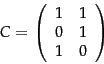
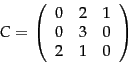
term-document matrix
  where (barring a rare coincidence)
 ; furthermore, is very unlikely to be symmetric. To this end we first describe an extension of the symmetric diagonal decomposition known as the singular value decomposition . We then show in Section 18.3 how this can be used to construct an approximate version of . It is beyond the scope of this book to develop a full treatment of the mathematics underlying singular value decompositions; following the statement of Theorem 18.2 we relate the singular value decomposition to the from Section 18.1.1 .
Given , let
; furthermore, is very unlikely to be symmetric. To this end we first describe an extension of the symmetric diagonal decomposition known as the singular value decomposition . We then show in Section 18.3 how this can be used to construct an approximate version of . It is beyond the scope of this book to develop a full treatment of the mathematics underlying singular value decompositions; following the statement of Theorem 18.2 we relate the singular value decomposition to the from Section 18.1.1 .
Given , let  be the
 matrix whose columns are the orthogonal eigenvectors of
 , and
, and  be the
 matrix whose columns are the orthogonal eigenvectors of
 . Denote by
  the transpose of a matrix .
Theorem.
Let  be the rank of the
matrix . Then, there is a singular-value decomposition ( SVD for short) of of the form
be the rank of the
matrix . Then, there is a singular-value decomposition ( SVD for short) of of the form
 of
are the same as the eigenvalues of
;
of
are the same as the eigenvalues of
;
 , let
, let
 , with
 . Then the
matrix
. Then the
matrix  is composed by setting
 for , and zero otherwise.
The values  are referred to as the singular values of . It is instructive to examine the relationship of Theorem 18.2 to Theorem 18.1.1; we do this rather than derive the general proof of Theorem 18.2, which is beyond the scope of this book.
By multiplying Equation 232 by its transposed version, we have
Note now that in Equation 233, the left-hand side is a square symmetric matrix real-valued matrix, and the right-hand side represents its symmetric diagonal decomposition as in Theorem 18.1.1. What does the left-hand side
represent? It is a square matrix with a row and a column corresponding to each of the  terms. The entry
  in the matrix is a measure of the overlap between the
  th and
  th terms, based on their co-occurrence in documents. The precise mathematical meaning depends on the manner in which is constructed based on term weighting. Consider the case where is the term-document incidence matrix of page 1.1 , illustrated in Figure 1.1 . Then the entry in
is the number of documents in which both term and term occur.
th terms, based on their co-occurrence in documents. The precise mathematical meaning depends on the manner in which is constructed based on term weighting. Consider the case where is the term-document incidence matrix of page 1.1 , illustrated in Figure 1.1 . Then the entry in
is the number of documents in which both term and term occur.
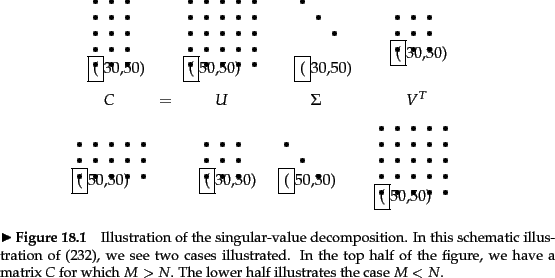
When writing down the numerical values of the SVD, it is conventional to represent as an  matrix with the singular values on the diagonals, since all its entries outside this sub-matrix are zeros. Accordingly, it is conventional to omit the rightmost
  columns of corresponding to these omitted rows of ; likewise the rightmost
  columns of are omitted since they correspond in
  to the rows that will be multiplied by the columns of zeros in . This written form of the SVD is sometimes known as the reduced SVD or truncated SVD and we will encounter it again in Exercise 18.3 . Henceforth, our numerical examples and exercises will use this reduced form.
Worked example.
We now illustrate the singular-value decomposition of a  matrix of rank 2; the singular values are
 and
and  .
.
End worked example.
As with the matrix decompositions defined in Section 18.1.1 , the singular value decomposition of a matrix can be computed by a variety of algorithms, many of which have been publicly available software implementations; pointers to these are given in Section 18.5 .
Exercises.
. What is the interpretation of the diagonal entries of
when is a term-document incidence matrix?
is a binary term-document incidence matrix. What do the entries of
represent?
; observe that its entries are largest where two terms have their most frequent occurrences together in the same document.