Kirrkirr: software for the exploration of indigenous language dictionaries

Contents
What's new? | Project
description | Screen shots |
Downloads and shipping versions |
Using dictionaries with Kirrkirr |
Publications, etc. |
Other links
- Jan 2021
-
-
See below for an interim release of
Kirrkirr.jar which works better with modern Java (e.g., Java 11 or Java 15).
- Aug 2020
-
-
David Nash updated his page of Instructions to set up the full Warlpiri Dictionary in Kirrkirr.
- Sept 2018
-
-
Kirrkirr is one source of information used for the Tracks Dance Company's Milpirri Banners 2018 pages, made in advance of the Nov 3 2018 Milpirri performance. And the Warlpiri dictionary data underlying Kirrkirr has received a big updating in a new coordinated effort – see the updated "Multi-Media" photo below.
- Jan 2014
-
-
There are a couple of mentions of Kirrkirr in Samantha Disbray's chapter: Samantha Disbray. 2014.
Evaluating Bilingual Education
in Warlpiri schools in Rob Pensilfini, Myfany Turpin, and Diana Guillemin (eds), Language Description Informed by Theory,
John Benjamins, pp.25–46.
- Jul 2013
- Mary Laughren mentions Kirrkirr
in her paper
From Linguistic Research Findings to Useful Products for Australian
Aboriginal Communities in eTropic 12(1) Special issue on Transoceanik: Academic Research & Public Domains.
- 2010
- Aidan Wilson discusses various uses of Kirrkirr and mobile phone dictionary programs in his paper
Electronic dictionaries for language reclamation
in John Hobson, Kevin Lowe, Susan Poetsch and Michael Walsh (eds.),
Re-awakening
languages: theory and practice in the revitalisation of Australia’s Indigenous languages,
Sydney: Sydney University Press, 2010.
Dawn Bates and Deryle Lonsdale made use of Kirrkirr for Lushootseed:
Dawn Bates and Deryle Lonsdale. 2010.
Recovering and updating legacy dictionary
data. In Papers for the 44th Annual International Conference on Salish and Neighboring
Languages, Missoula, MT. (Eds. Joel Dunham and John Lyon), University of British
Columbia Working Papers in Linguistics Vol 27, pp. 1-12.
- Oct 2008
- Kirrkirr 4.0.3 is available for all platforms
packaged as a simple zip file. (This is not an installer; simply unpack
the Zip file, navigate to the "Kirrkirr 4.0.3" folder, and double
click on the click.jar file (or the Kapp.bat file on Windows). Before
doing this, you will also need to install Java, if you
don't already have it.
- Press: Kirrkirr is mentioned
in the Sydney Morning Herald, and Kirrkirr makes a brief cameo appearance towards the end of
an SBS World News
segment. See
here and
here
for more info on Kaurna Kirrkirr and a new mobile phone dictionary program.
James McElvenny published a review of Kirrirr
in LLanguage Documentation and Conservation, 2(1): 160–165.
- Jul 2007
- We released Kirrkirr 4.0.3 for Mac OS X.
- Jul 2007
- Did your copy of Kirrkirr just die? (Or it won't run when you install
it?) Are you using a Mac on which you've installed Elan? If so, see here.
- Jun 2006
- We demonstrated Kirrkirr at
E-MELD
2006, showing Kirrkirr
working with FIELD format dictionaries and the new wizard for importing
dictionaries into Kirrkirr (coming to this site later this year).
- Jul 2005
- Kirrkirr 4.0.2 is available for free download. This version mainly
fixes a few bugs in version 4.0, but adds one great new capability:
being able to change dictionaries while Kirrkirr is running.
- Apr 2004
- If you or your library have an International Journal of
Lexicography subscription, then you should be able to read
our recent article on indigenous dictionary usability (with some
discussion of Kirrkirr),
How
useful and usable are dictionaries for speakers of
Australian Indigenous languages?.
- Jan 2004
- Kirrkirr 4.0 is available for free download. It comes with a couple of
tiny sample dictionaries, and you can add your own dictionaries.
- Dec 2003
- We've put up on the web site
instructions and requirements for
making a
dictionary usable inside Kirrkirr, and
information on the additional files that are needed to make things work.
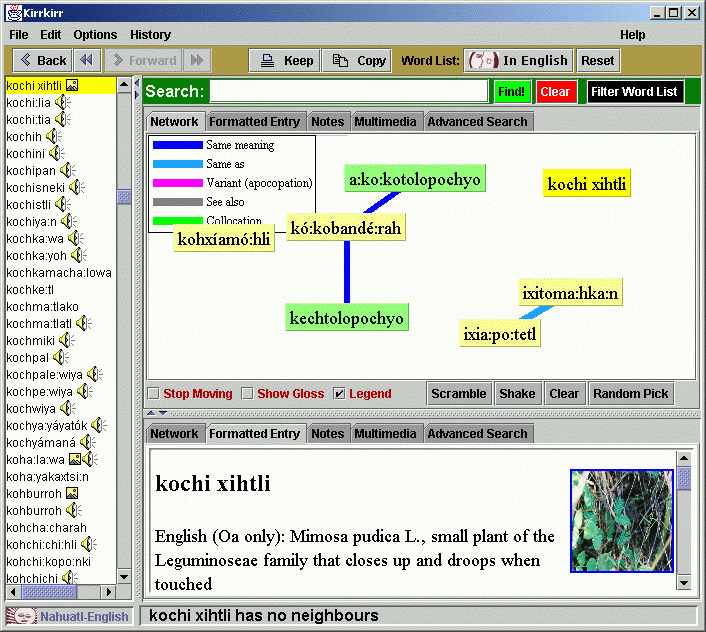
Kirrkirr is a research project exploring the use of computer software
for automatic transformation of lexical databases ("dictionaries"),
aiming at providing innovative information visualization, particularly
targeted at indigenous languages. As a first example, it can generate
networks of words, such as in the little picture above, automatically
from dictionary data.
Kirrkirr aims at a perceived gap in work being done elsewhere: while
there is a lot of work on designing dictionary databases, and
providing software for building and maintaining these databases,
there is a dearth of work that exploits these databases to
provide useful and fun tools for nontechnical end users.
Some more specific subgoals have been:
- To provide new capabilities for easy browsing of dictionary
information: Most computer dictionaries simply provide a
search box into which one can enter a word, but there are a
lot of other ways in which one might wish to browse,
search, or learn, such as exploring words via semantic
domains, or solving a crossword.
- To make available new ways of visualizing and presenting dictionary
information, personalized to different users:
Most dictionary programs simply give you standardly formatted textual
entries, but there are many ways to customize textual
information or to provide different visual organizations
of this information. For example, one can provide simple,
short entries to younger viewers.
- To provide an interesting and fun experience, through use of
animated words, audio, pictures, and games. Kirrkirr should be
sufficiently entertaining that children will enjoy
playing with it, with incidental learning occurring as they explore.
For instance, conventional paper dictionaries expose users to words that
are nearby in terms of spelling (and which are often
morphologically related), whereas most computer
dictionaries lack this capability. Kirrkirr goes beyond
the paper dictionary by introducing you to other words
that are related in meaning or use, and providing
activities such as picture-matching games.
- To meet the needs of native speakers and children, as well as
being useful to professional linguists. On the one hand, this
introduces particular
usability concerns, such as making the program accessible
to people with limited language and literacy skills, while on
the other hand, we wish to provide advanced searching
facilities, such as extended regular expressions, as are often
used by linguists looking for particular linguistic patterns.
- To automatically provide dictionary reversals, so that an underlying
L1-L2 dictionary (e.g., Finnish-English) can be automatically used as an
(imperfect, but usable) L2-L1 (e.g.,
English-Finnish) dictionary.
The central idea motivating our research is that given any sort of
well-structured lexical database, software should be able
to automatically provide all sorts of value-added
functionality. In recent years, there has been an enormous
amount of work on different proposals for structuring and
storing lexical databases, but almost no work on providing
electronic dictionary interfaces which make use of this
structure to provide human access and usability through information
transformation and visualization. Kirrkirr explores ways of
solving this unaddressed need.
What Kirrkirr isn't. Looking at things from the reverse
direction, Kirrkirr isn't a
tool for building or maintaining dictionaries. Kirrkirr requires a
well-structured dictionary to already exist, and doesn't help you with
the mechanics of building one. However, it can be a very
useful adjunct tool during the dictionary construction process, since
the alternative visualizations that it provides can make it very easy to
see errors, inconsistencies, and areas of incompleteness in a
dictionary. For example, a
common way to build up dictionaries is by semantic domains, and Kirrkirr
lets you visualize the dictionary via semantic domains.
Details:
Kirrkirr is designed so that it can work with almost any
dictionary in XML format
(XML is a new-ish, but
already widespread standard for representing textual and other
data, especially on the WWW).
Most of our initial experience and papers concern applying
the dictionary to Warlpiri, an Indigenous Australian language,
but Kirrkirr now runs with dictionaries for a variety of languages,
including
Lushootseed,
Nahuatl, an Indigenous
language of Mexico; Warumungu
Warnman,
Ngardi,
Gurindji,
Umpithamu;
Bardi,
Waanyi,
Kaurna,
Dharug,
Wagiman;
Biao Min; and
even English.
Kirrkirr achieves this flexibility through use of a
dictionary specification file (also in XML, mainly using XPath) which maps
dictionary constructs to Kirrkirr constructs. Such a file does have to
be written for each dictionary schema.
Formatted entries are rendered using parameterized XSLT files, which can
be customized for each dictionary schema.
Other dictionary access is by XPath expressions
accompanied by regular expression matching.
The program is written in Java. Where possible we run it using current
Java versions, but it is compatible with JDK1.1.8+Swing1.1 (!). (For years
this was necessary so that we could run it on MacOS 8.1+ or 9 still present on old computers in Outback schools – but no more,
in the 2010s!)
For example,
this picture shows
Kirrkirr 4.0.2 running (slowly!) on a Power
Macintosh 7500/100 under MacOS 8.6 in July 2005.*
People
Following initial discussions between Jane Simpson and Nitin Indurkhya, Kirrkirr was initially designed and built by Kevin Jansz, Christopher
Manning, and Nitin Indurkhya, during 1998–1999. Jane Simpson, Miriam Corris, Susan
Poetsch, Ben Hutchinson, and others contributed design ideas and
work in user testing and dictionary usability, 1999–2004.
Further development and programming was done by students at Stanford and Nanyang Technological University from 2000–2002 by Vijay Chemburkar,
Jessica Halida Harjono, Andrew Lim Hong Lee, Kevin Lim, Madhuvanti Pawar, Andrei Pop, Jim Wee Sng, Conrad Wai,
with especially big contributions by Kristen Parton.
Since 2003, maintenance and occasional further development has been done by Christopher Manning.
Data
This project and the examples on these web pages use data
from various indigenous languages.
The Warlpiri dictionary data is from the Warlpiri
dictionary project kindly supplied to us by
Mary Laughren.
This data was collected by Ken Hale, Robert Hoogenraad, Mary Laughren,
David Nash, Jane Simpson, and others from many Warlpiri, and is used with
permission. The Nahuatl dictionary data comes from a dictionary
constructed by Jonathan
Amith, and is used with permission.
The data on this site is for demonstration purposes only.
This data remains the property of its traditional owners.
Please do not reproduce or further distribute it without permission.
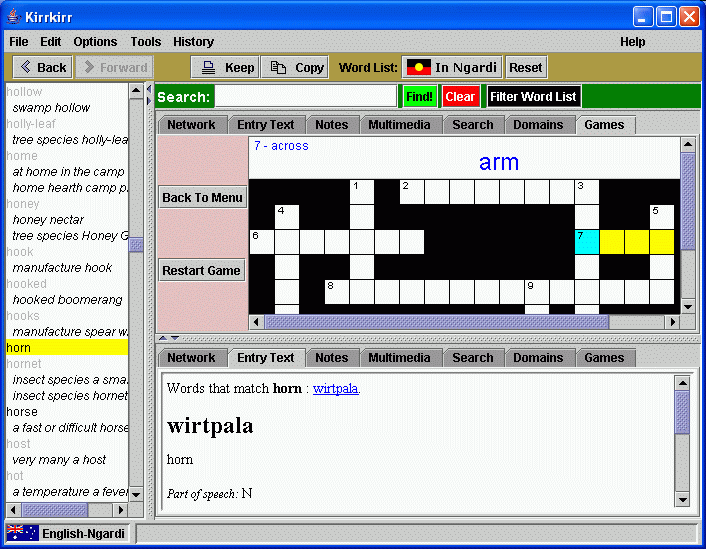
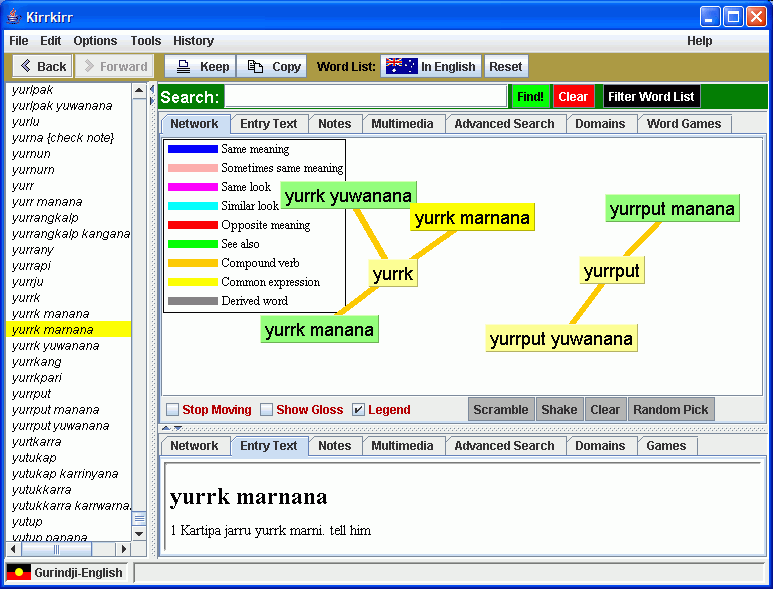
The program provides a left hand side word list (which can show either
L1 or L2 words), top menus, icons, and searchbox, and then a main
panel area, which can be split in two, which shows one or two of
the seven main panes of Kirrkirr. Some pictures of these panes appear
below (click on the pictures to see a full size view). Many of
these pictures are from old versions of Kirrkirr and haven't been
updated recently; the Nahuatl pictures immediately below and under
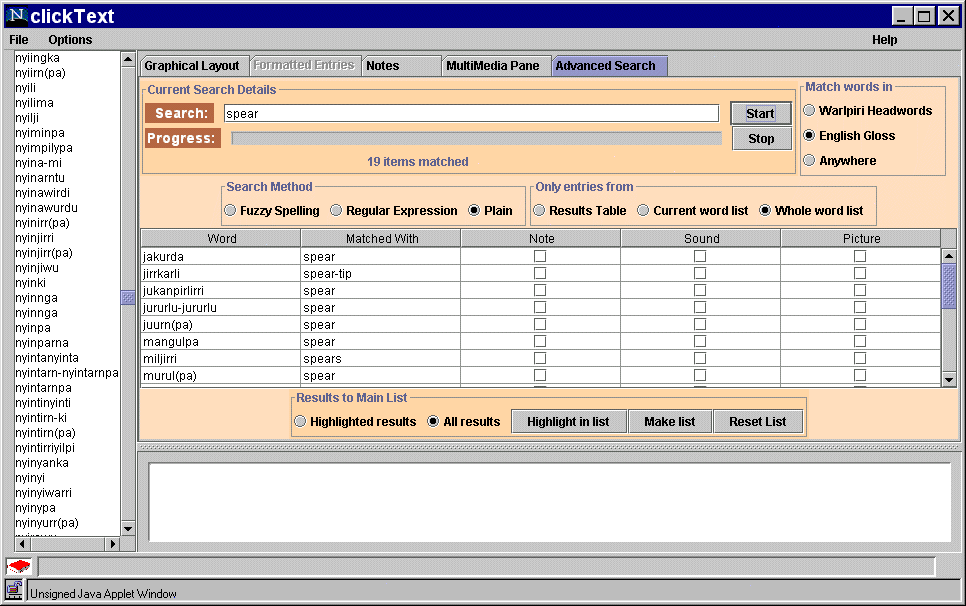
Advanced Search show recent views.
-
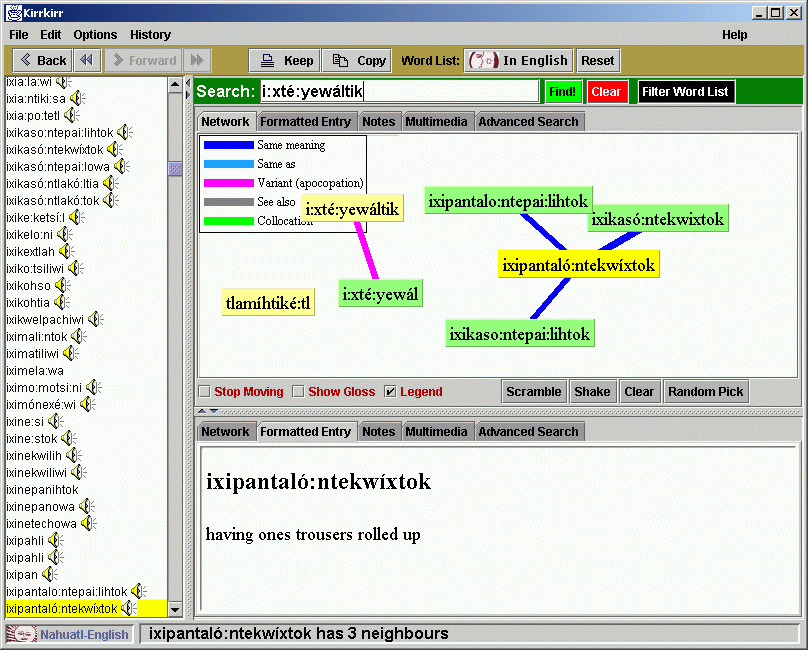
Network display of semantic relationships
|
Clicking on a word in the word list
makes the word (or its L1 translations) appear in the Network pane,
surrounded by its related words.
Clicking on the right mouse button will give you a few options
such as:
-
see definition: open up a small window with the full dictionary
entry in it and your notes
-
pin down: stop the word from moving around
In the middle of the window is a search box where you can type in a word.
The word list scrolls as you type, but you can also hit enter or click
Filter to get it to highlight or to only show the
words that match in the list.
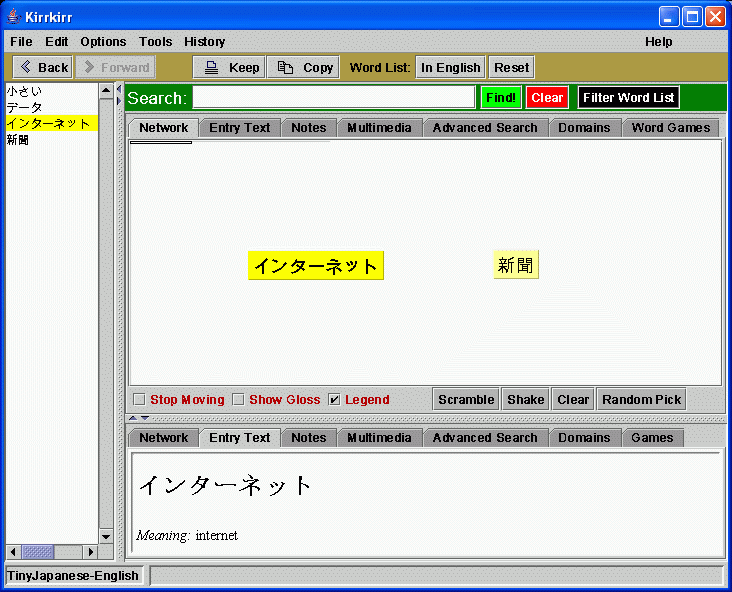
Kirrkirr uses Unicode internally, and can also work with dictionaries
using other character sets.
|
|
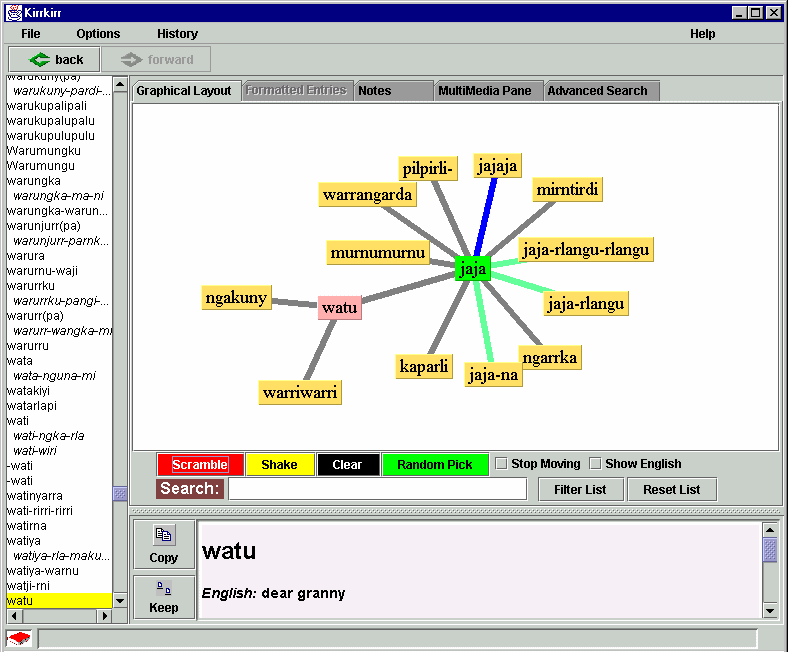
Clicking your left mouse button
on a word will "sprout" its related words around it. (The words
will move around until they're almost evenly laid out - that is, if you don't
scramble or shake them)
Clicking on the Options|Edit menu will bring up the options window,
one panel of which lets you edit the behaviour of the "floating" words.

|

|
The multi-media pane will let you listen
to the pronunciation of the current word (highlighted in the
list on the left) or perhaps play a sound of what the word is about, or
show you pictures. [Historical look: you can look at
3 views of this panel over time..]
|

|
The Formatted window gives a traditional
dictionary view of an entry, except with the advantage of web-like
hyperlinks to cross-reference Warlpiri words. These links are
colour-coded to match the links in the
graphical network window. When clicked, the program will jump to the
entry for the hyperlinked word. |
|
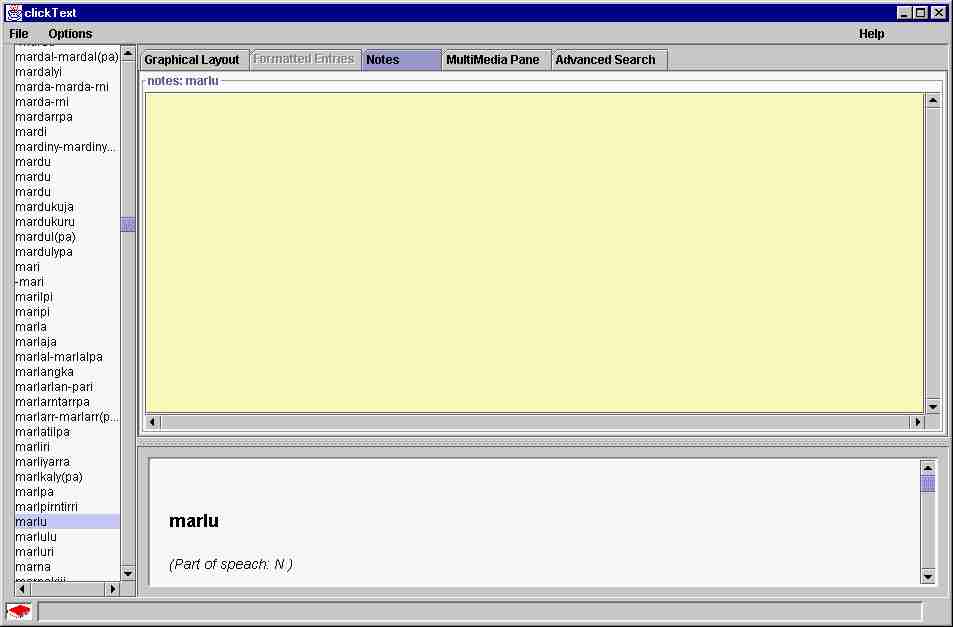
This lets you make notes about the current dictionary
word. These notes can be opened in their own window (like post-it
notes) by using the "see definition" option when you right click on a
word. Notes can be saved on a per-user basis, so as to allow users to
annotate their own copy of the dictionary. |
|
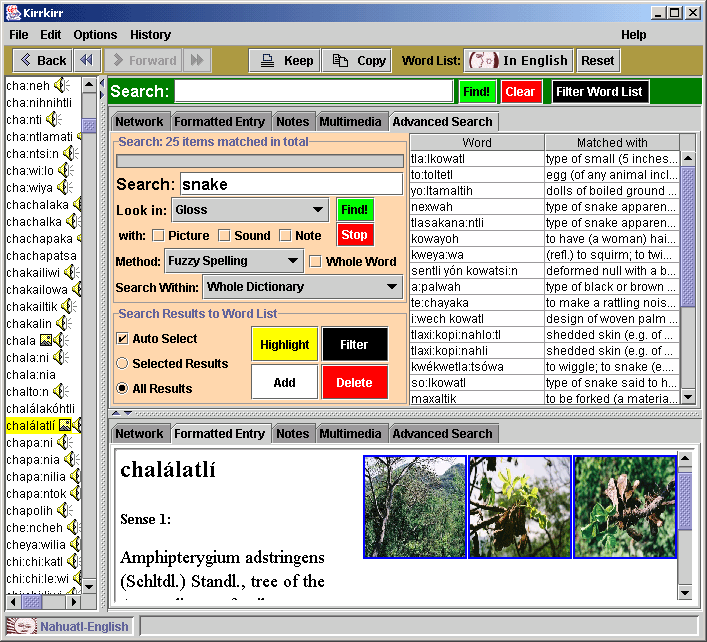
To look up a word in a paper dictionary, you
either need to know the correct spelling, or to scan around looking for
it. Most e-dictionaries make the latter more difficult. In Kirrkirr,
you do not need
to know the exact spelling of a word to look it up.
Words can be found using spelling that "sounds-like" the
word. Choose the "fuzzy spelling" option in the Advanced Search
part
of Kirrkirr to have it find words that approximately match your
query. Fuzzy spelling is also used behind the scenes for the front pane
search box. More experienced computer users can search by regular
expressions to find things in the headwords,
English glosses, or
anywhere in a dictionary entry. |
|
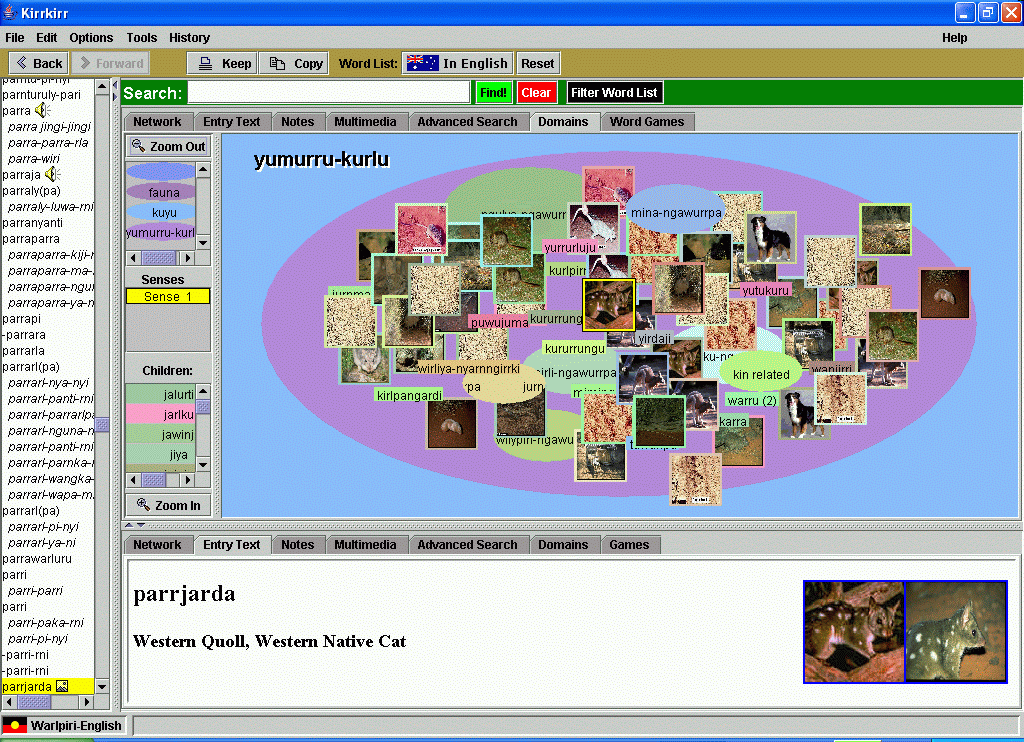
The semantic domain explorer window lets you
explore L1 words organized via their semantic
domains. |
|
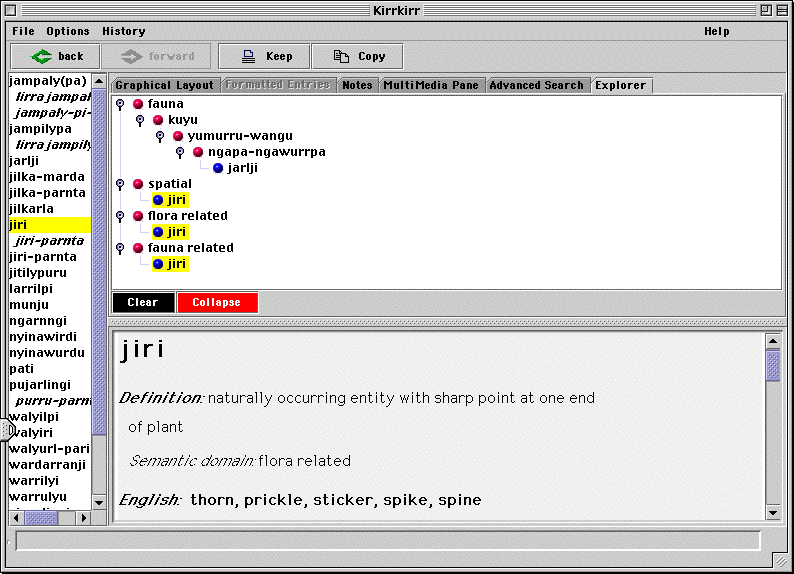
There is also an older tree-structured view
of words by semantic domains.
|
|
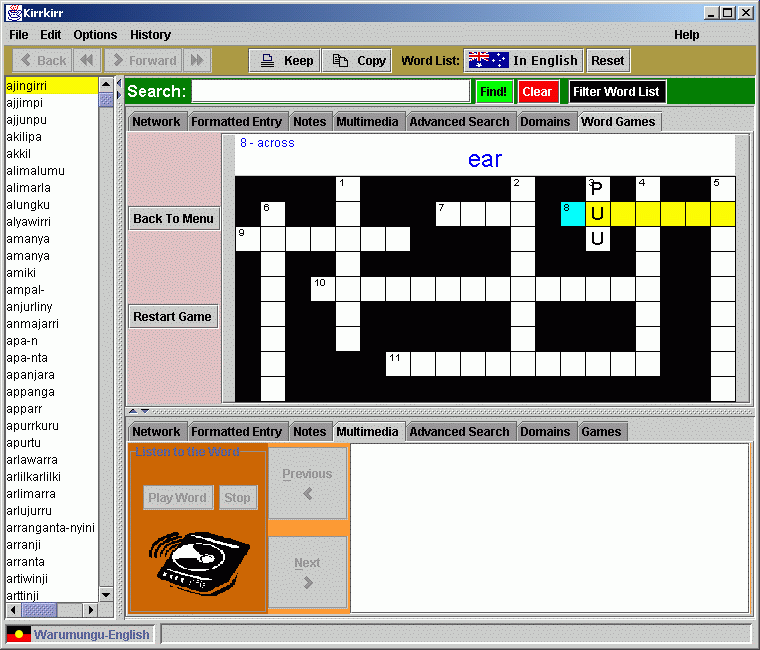
The crossword is one of several word games
that can be played based on dictionary data. It is
generated automatically from the dictionary (a new game each time!)
taking account of the level of difficulty of
words. |
-
Dictionary Reversal (English-x dictionary)
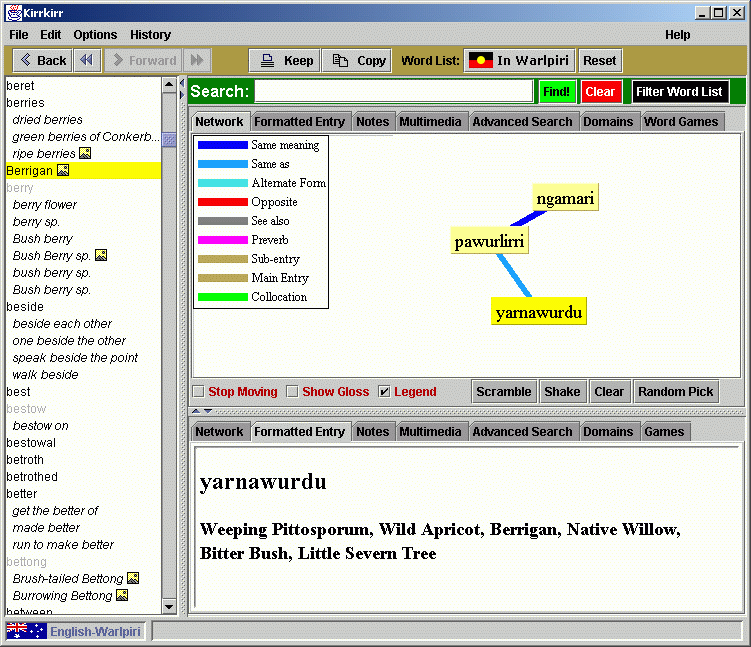
|
The dictionaries we are using (like many
indigenous language dictionaries) are available only as
x-English dictionaries, but Kirrkirr automatically
produces a reversal to an English-x dictionary which gives
reasonably effective access to the dictionary data in the
other direction -- rather better than the traditional
finderlist solution. (The second language doesn't have to
be English, one can also do Spanish-Nahuatl, or whatever.)
|
Kirrkirr interim 2021 release: Here's a version of Kirrkirr which will work with modern Java (e.g., Java 11 or Java 15) and modern operating systems (e.g., macOS Catalina). First, download and install a version of Java such as Java 11 or 15 with HotSpot JVM, perhaps from AdoptOpenJDK. Note: You need a mininum Java version of 11 to use this version of Kirrkirr. 6 or 8 won't work. Then download this Kirrkirr-interim-2021-release.zip, unzip it, and put all the contained .jar files in the folder where your current Kirrkirr.jar or click.jar is (i.e., the Kirrkirr folder). Finally, if on macOS, the first time you run things, you need to override the recent macOS malware safety protections. Hold down the Control key and click the Kirrkirr.jar icon, choose Open on the menu that pops up and then click Open on the security dialog that pops up. Then, Kirrkirr should run. Thereafter, you should be able to run Kirrkirr fine by just double-clicking on the Kirrkirr.jar icon. (Note that the old application launcher will not work. You can delete it if you wish.) Hopefully, later in 2021, I can make a new installable Kirrkirr for modern systems and so things won't be so makeshift….
Kirrkirr 4.0.3 is the current version of Kirrkirr. It is a maintenance release available for all platforms.
It's basically the same as Kirrkirr 4.0.2 but has a few
fixes and works around a couple of specific problems.
For (Mac) OS X, it requires OS X 10.4 or above with Java 5 or later installed,
and works with any version of OS X including Mavericks and beyond
(for Mac OS X 10.4, Java 5 was released via a system update in
Apr 2005; for Mavericks, you may need
to get Java). It
is the most Mac UI
compatible Kirrkirr ever, but it was released mainly to avoid
problems that ELAN version 2.5+ were causing for
Kirrkirr users. For Windows or Linux, we provide a simple zip file, since the
(old) ZeroG InstallAnywhere installer that we previously used no longer
works with recent operating system releases. You need
to get Java, unpack the zip file,
navigate to the "Kirrkirr 4.0.3" folder, and then double
click click.jar (or Kapp.bat on Windows).
Knowledgeable users can
use this zip file on any operating system with Java available.
This version can be used with most XML
dictionaries, when properly configured (see the
instructions). The version
downloadable from the web comes only with
a few tiny sample and tutorial dictionaries. It starts up with a
32 word extract from the Warlpiri Dictionary.
We send versions of Kirrkirr
with complete dictionaries on CD to appropriate people
(indigenous intellectual property concerns limit the free downloading
of this dictionary data). If you have a folder of dictionary content,
you can drop it into the "Kirrkirr 4.0.3" folder, and it will then be
available to choose as a dictionary under the Preferences/Options tab
for Configure. This version of Kirrkirr runs only as an application.
Kirrkirr 4.0.2
Use of this version is no longer recommended for any operating
system. The Windows and Linux installers do not work with recent distributions.
Kirrkirr 3.0.1 was previously the most widely used version of
Kirrkirr. This version provided a stable Warlpiri dictionary version
of Kirrkirr. This version ran only as an application. It is now
obsolete.
Kirrkirr 1.1 and Kirrkirr 2 ran both as applications
and over the
web. For various reasons, Kirrkirr 1.1 has aged more gracefully,
and still runs fine in the average web browser, whereas Kirrkirr 2
doesn't, so we've kept a version of Kirrkirr 1.1 here as both an
historical relic, and as an easy way to take a quick look at
something running. It runs with a tiny sample Warlpiri dictionary.
Comments and bug reports
All comments and suggestions are welcome. Email
manning@stanford.edu.
Bug reports are appreciated, but bugs are much more likely to be
fixed if we can understand what caused them. If there is a repeatable
sequence of actions that causes it to freeze, sending a way to reproduce
the problem usually allows it to be fixed.
Kirrkirr can be used with virtually any XML dictionary, once
appropriate configuration, dictionary specification and entry rendering
files are available. Some pages describing what
you need to do are available.
Journal articles:
- Miriam Corris, Christopher Manning, Susan Poetsch, and Jane
Simpson. 2004. How useful and usable are dictionaries for speakers of
Australian Indigenous languages? International Journal of
Lexicography 17:33-68.
[pdf
on publisher's site]
- Christopher D. Manning, Kevin Jansz, and Nitin
Indurkhya. 2001. Kirrkirr: Software for browsing and visual exploration of a
structured Warlpiri dictionary. Literary and Linguistic
Computing 16(2): 135-151. [Prefinal version:
PDF or
PS.]
Refereed conference papers:
-
Kevin Jansz, Christopher D. Manning, and Nitin Indurkhya. 1999.
Kirrkirr: Interactive
Visualisation And Multimedia From A Structured Warlpiri
Dictionary. Proceedings of AusWeb99, the Fifth Australian World
Wide Web Conference, pp. 302-316.
- Kevin Jansz, Jim Wee Sng, Nitin Indurkhya, and Christopher Manning. 2000.
Using
XSL And XQL For Efficient Customised Access To Dictionary Information.
Proceedings of AusWeb 2000, the Sixth Australian World
Wide Web Conference. pp 167-181.
- Christopher D. Manning, Kevin Jansz, Nitin Indurkhya. 2000. Kirrkirr:
Software for browsing and visual exploration of a structured Warlpiri
dictionary. Paper presented at ALLC
/ ACH 2000, The Joint International Conference of the
Association for Literary and Linguistic Computing and the
Association for Computers and the Humanities (abstract pp. 58-60 of talk
abstracts). [local copy of presentation]. Published
in LLC (see above).
-
Miriam Corris, Christopher Manning, Susan Poetsch, and Jane Simpson.
2000. Bilingual dictionaries for {A}ustralian languages: User studies on
the place of paper and electronic dictionaries.
In Proceedings of the Ninth Euralex International Congress
(Euralex 2000), pp. 169–181, Stuttgart.
Chapters in books:
-
Miriam Corris, Christopher Manning, Susan Poetsch, and Jane Simpson.
2002. Dictionaries and endangered languages.
In David Bradley and Maya Bradley (eds.), Language Endangerment
and Language Maintenance, pp. 329–347. London: RoutledgeCurzon.
Previously presented at the Endangered Languages Workshop, La Trobe
University, 1999, and the 1999 Perth Congress of the Applied Linguistics
Association of Australia.
Workshop papers:
Theses/Final year project reports:
-
Kevin Jansz. 1998. Intelligent
processing, storage and visualisation of dictionary information.
University of Sydney Computer Science Honours thesis.
- Jim Wee Sng. 2000.
Optimising
Kirrkirr: An electronic dictionary browser.
Final Year Project, School of Applied Science, Nanyang Technological
University, Singapore. Technical report AS00-CE-F076.
- Madhuvanti Pawar. 2001.
Technologies for Language Learning.
Final Year Project, School of Computer Engineering, Nanyang Technological
University, Singapore. Technical report SCE00-085.
- Andrew Lim Hong Lee. 2001.
Customizing Kirrkirr for the Microsoft Browser.
Final Year Project, School of Computer Engineering, Nanyang Technological
University, Singapore. Technical report SCE00-083.
- Jessica Halida Harjono. 2001.
XUL Application Development.
Final Year Project, School of Computer Engineering, Nanyang Technological
University, Singapore. Technical report SCE00-087.
Miscellaneous:

http://nlp.stanford.edu/kirrkirr/
Christopher Manning
-- <manning@cs.stanford.edu>
--
Last modified: Tue Aug 14, 2018